AI search
AI sends you 0.1% of your traffic. It may already decide who buys from you.
AI assistants send almost no traffic, read your site relentlessly, and hand over the buyers most likely to convert. All three are true at once.
The Agentarius Review Desk5 min read
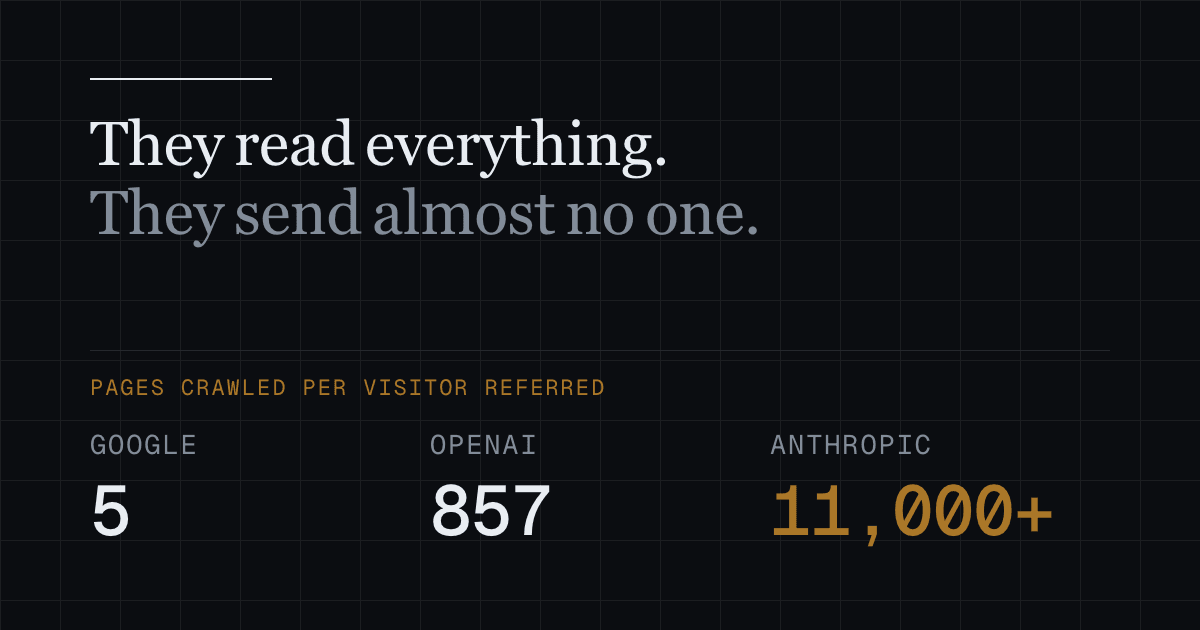
Three numbers that shouldn't belong in the same paragraph.
AI tools like ChatGPT send websites almost no traffic. About 0.1%, according to Ahrefs, who checked 82,000 sites.
That tiny trickle grew 16x in two years (SE Ranking).
And the people who do click through buy 31% more often than everyone else (Adobe).
So which is it? Ignore AI search because it's nothing? Or take it seriously because it's the fastest-growing, highest-converting source you have?
Both. And that contradiction is the whole story. Most articles about GEO skip it entirely, because it's easier to sell you ten tips than to explain what's actually going on.
Generative engine optimisation, or GEO, is the work of getting your content cited when an AI assistant answers a question, rather than clicked in a list of links.
Here's one more number, and it's the one that changed how we think about this.
For every single visitor OpenAI sends to a website, its crawler reads 857 pages. Anthropic reads over 11,000 pages per visitor sent. Google? Five.
Let that sink in. AI systems are reading your website constantly. They're just not sending anyone back. Your content is being consumed at a scale your analytics will never show you.
What your buyers are doing right now
Watch anyone research software today. They don't google "best CRM" and open ten tabs anymore. They open ChatGPT and type something like: "We're a 12-person sales team, mostly outbound, budget around $50 per seat. What should we use?"
They get four or five names back.
There's no page two. If you're not in that answer, that buyer will never know you exist. And nothing in your dashboards will ever tell you it happened.
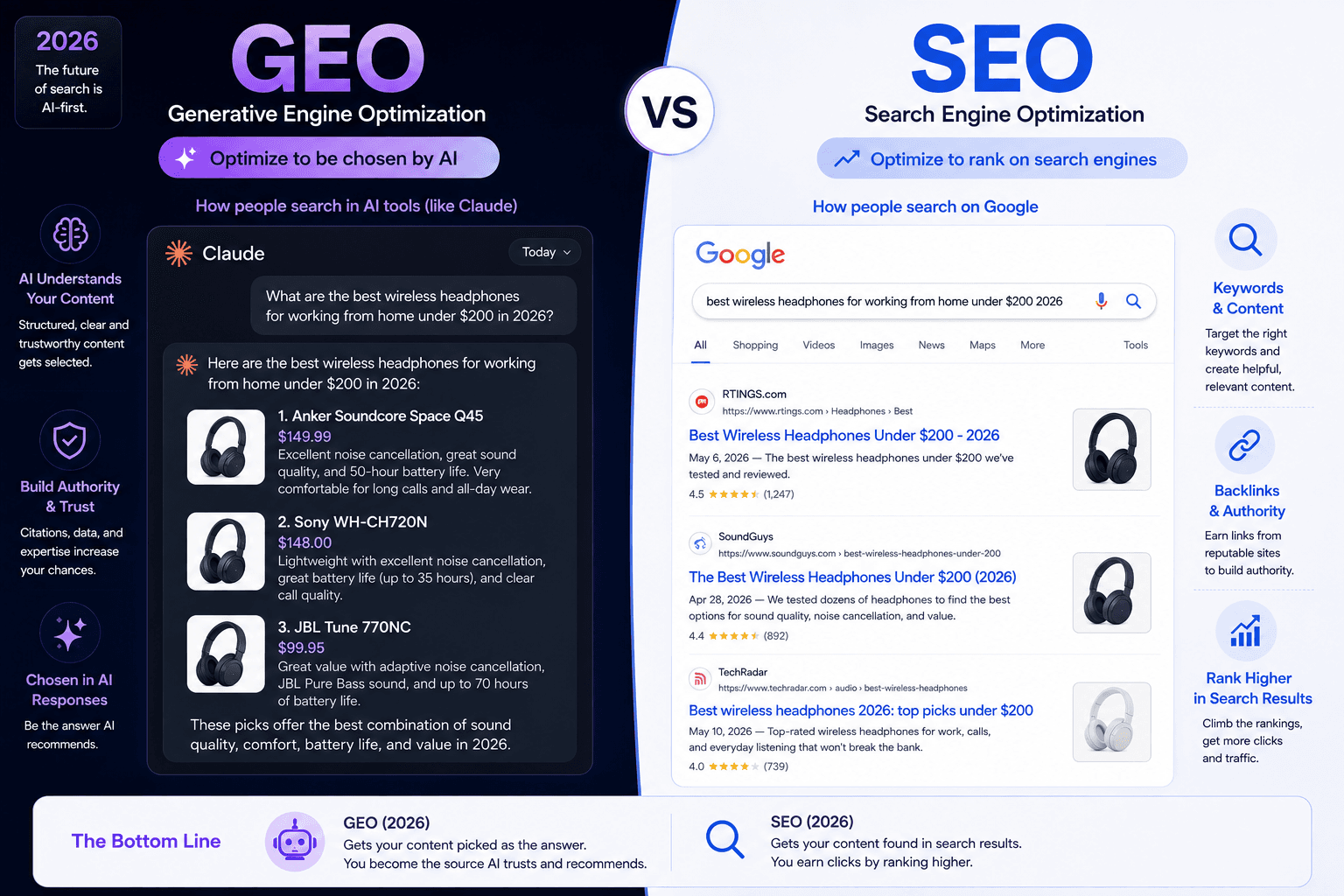
That's also why the conversion number makes sense. Someone arriving from an AI conversation isn't browsing. The AI already asked what they needed, filtered the market, and sent them to you as a finalist. That's a warm lead, pre-qualified by a machine.
Early Google traffic looked exactly like this around 2001. Small enough to ignore. Growing fast enough that ignoring it turned out to be expensive.
Nobody can measure this yet. Be suspicious of anyone who says they can.
Here's something the vendors won't tell you.
Three serious studies tried to answer one simple question: how much of AI traffic comes from ChatGPT? One says 92%. One says 75%. One says 63%.
Same question. Same year. Wildly different answers.
Not because anyone is lying. They measured different sites, different industries, with different methods. And most AI use happens inside mobile apps, where your analytics see nothing at all. Everyone is measuring the visible edge of something mostly invisible.
So when someone offers you a dashboard with your exact "AI visibility score," they're selling you precision that doesn't exist yet. We went deeper on this problem in our glossary entry on GEO, because honestly, the measurement gap is the real story here.
It also means something awkward for anyone reporting on marketing. For 20 years, "being found" and "getting a visit" were the same thing. One chart measured both. Not anymore. Your traffic can drop because your content stopped working, or because it's working so well that AI answers satisfy people before they ever click. Same falling line. Opposite meanings. The chart can't tell you which one you're looking at.
What actually gets you recommended
Once you strip out the noise, a few things hold up.
What others say about you beats what you say about yourself. Muck Rack looked at where AI systems pull their citations from. 84% came from third parties: journalists, industry sites, independent reviews. Not from company websites. AI treats your own site like a claim, not proof. Which means good old PR just became one of the strongest AI strategies available.
Describe yourself the same way everywhere. AI builds a picture of what your company is. If your website says "comparison platform," LinkedIn says "marketplace," and some directory says "productivity app," you've given the machine three stories to untangle. A human shrugs that off. The machine may just recommend the competitor it understands better.
Write things a machine can check. "Our revolutionary platform transforms how businesses work" is unusable. There's nothing in it. "We compare 150 AI tools by pricing, features and alternatives" can be quoted, verified, and dropped straight into an answer. Run this test on your homepage: could an AI repeat your claims and be right?
Help people choose, don't just describe. Nobody asks an AI "what is Claude?" as often as they ask "Claude or ChatGPT for consulting work?" The second question is where money changes hands. That's why we built Agentarius around comparisons and tool stacks instead of just product pages. The AI conversation is a decision. Your content should match its shape.
One warning before you get excited
Columbia's journalism school tested how well AI search engines cite their sources. They got it wrong more than 60% of the time.
So yes, being visible in AI answers also means being occasionally misquoted, mixed up with someone else, or described inaccurately. And there's no complaints department. Your only fix is publishing clearer material and waiting.
Fast-growing. High-intent. Badly measured. Frequently wrong about the details. That's the honest state of this channel.
What we'd actually do this quarter
Forget the strategy overhaul. Four habits.
1. Ask the AIs your buyers' questions, monthly. Write ten questions your real customers would type. Not your brand name, the actual questions. Run them through ChatGPT, Perplexity, Gemini and Copilot. Note whether you show up, how you're described, and who shows up instead. Save the answers. It's crude, but it's the closest thing to a rank tracker that exists right now.
2. Fix your descriptions. Website, LinkedIn, Crunchbase, directories. One consistent answer to: what are you, for whom, solving what.
3. Count your independent mentions. If the answer is "almost none," that's your bottleneck. One real piece of third-party coverage probably beats ten new blog posts.
4. Make your claims checkable. Go through your top pages. Replace every vague statement with a specific one a machine could verify.
None of this guarantees an AI recommends you next month. Nothing does; the systems change too fast. What it builds is something more durable: a clear, consistent, independently confirmed picture of what you are. Clear enough that leaving you out of the answer becomes the exception, not the default.
Your buyers haven't stopped doing research. They've started delegating it.
Which leaves one question that matters more every month:
When the AI builds the shortlist, are you on it?
Agentarius is an independent AI discovery, comparison and learning platform. We document the vocabulary of this shift, including GEO, in the Agentarius AI Glossary.
Sources: Ahrefs (82,000-site referral study); SE Ranking; Adobe Digital Insights (Jan 2026); Cloudflare Radar (crawl and referral data, 2026); Previsible; Goodie; Muck Rack (May 2026); Tow Center for Digital Journalism, Columbia University.
The AI tools guide
Every tool in the guide carries what it is for, who it suits, what it costs and the date its facts were last checked.
Published 17 August 2026